FAQ

Evergreen™, explained

Answers to the questions we hear most — about the project, privacy, and well-being at Dartmouth.

The essentials

Evergreen at a Glance

What it is

Evergreen is an AI-powered wellness platform designed by students for students – and supported by leading faculty in AI and behavioral science – that integrates AI with optional behavioral-sensing data such as sleep patterns, activity levels, and stress indicators to deliver brief, science-based check-ins, nudges, and personalized recommendations that help students build resilience and flourish at Dartmouth and beyond. The goal is to help students flourish, offering evidence-based support early, when it can do the most good.

The Oct. 10, 2025 announcement of Evergreen's launch details the platform's functionality, the projected timeline for testing and rollout, the foundational Dartmouth research behind its development, and the motivation of the students and faculty dedicated to the project.


Three Evergreen students talking through ideas at a table during a working session
Why it matters

This expands the well-being services and resources at Dartmouth by adding a student-built, supportive tool that will provide proactive, continuous well-being support grounded in evidence-based research in digital interventions.

Who's involved

Built by Dartmouth students working with Dartmouth faculty at every level of design and development, and led by the Center for Technology and Behavioral Health (CTBH) — Evergreen's home, based in the Geisel School of Medicine. Thrive Global has an advisory role as part of a non-binding, non-commercial partnership. Thrive is available to provide free content strategy guidance as well as scalable know-how, should other universities be interested in adopting customized versions of Evergreen on their own campus. Thrive does not have access to any student data.

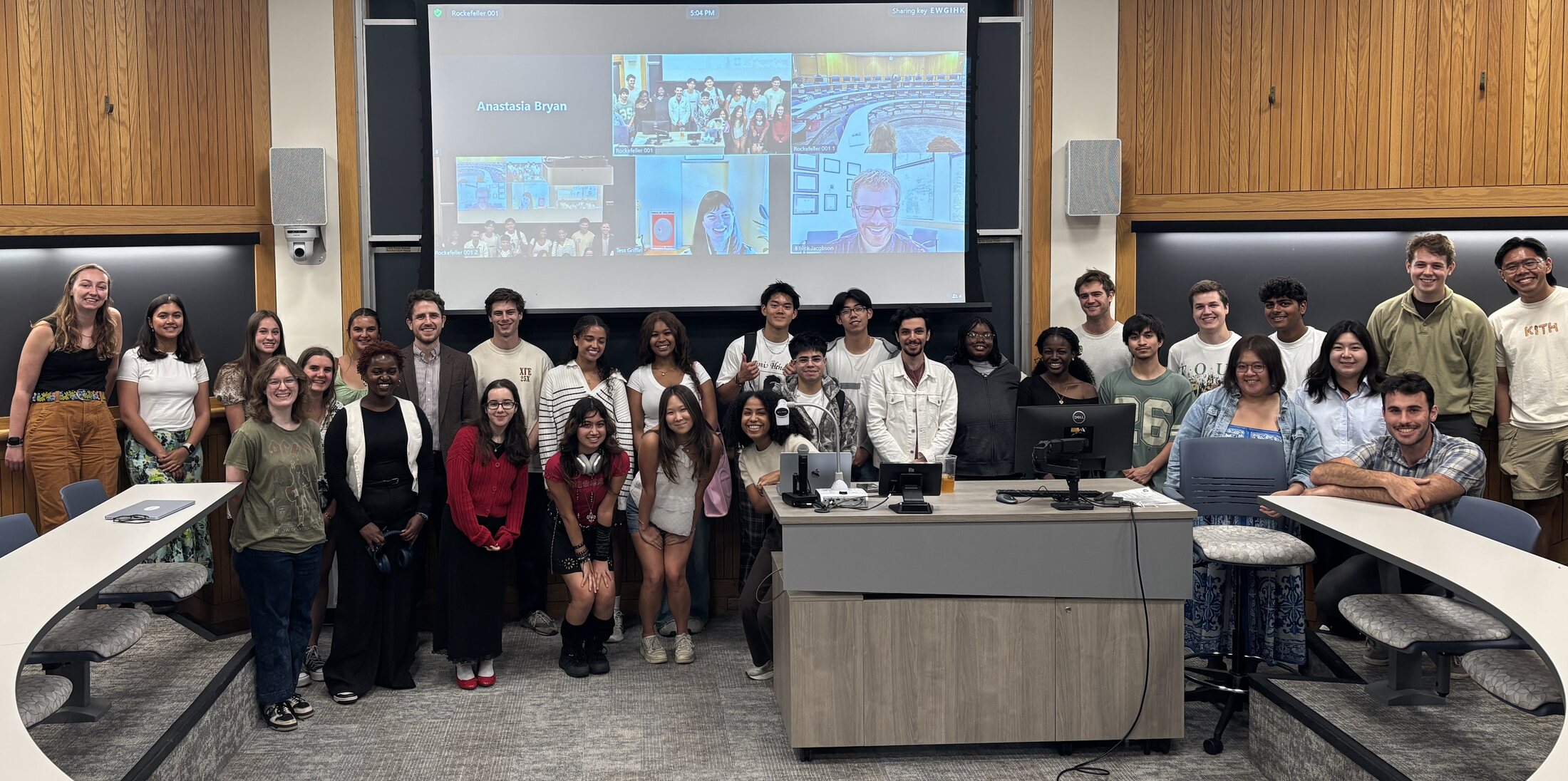
Evergreen team members filling the room at a fall general meeting
First all-hands meeting of Fall 2025, including students at all levels, staff developers, research coordinators and project leadership.
The short version

What Evergreen is — and isn't

Evergreen is:

  • Student-designed and student-built
  • Opt-in
  • Privacy-first
  • Evidence-informed
  • Overseen by Dartmouth faculty
  • Intended to supplement existing Dartmouth services

Evergreen is not:

  • AI therapy
  • Mandatory
  • A replacement for counseling or emergency services
  • A consumer chatbot

About the Project

Why are we building Evergreen now?

College moves fast, and the science and tools for supporting student well-being are advancing just as quickly.

Dartmouth – where the term "AI" was coined – remains at the forefront of technology and mental health, from creating the first FDA-cleared digital therapeutics to leading the longest mobile sensing study of student well-being. Evergreen translates decades of research into a practical, student-built, student-centered tool that harnesses AI responsibly. Its goal is not only to provide individualized guidance, but also to foster resilience, strengthen community, and prepare students to thrive through times of uncertainty.

How does Evergreen work?
  • Students opt in and choose what (if any) data to share.
  • Evergreen offers brief, science-based check-ins and nudges tailored to the student and the wellness goals they've identified.
  • If students opt in to sensing, Evergreen can adapt suggestions using signals like sleep and activity patterns.
  • Evergreen focuses on ways to help students flourish, and does not replace counseling or emergency services.
What's inside the build?
  • Evergreen is held to the same rigorous research standards as any research-based endeavor and informed by CTBH's fifteen years of innovative research in digital interventions, particularly by Evergreen's lead faculty, Lisa Marsch (Founding Director, CTBH; behavior change and addiction), Nicholas Jacobson (clinical psychologist and AI therapy researcher), Andrew Campbell (behavioral sensing pioneer), and Michael V. Heinz (psychiatrist and clinical AI researcher).
  • Evergreen will be trained on 100,000+ hours of student-curated, expert-reviewed therapeutic dialogue to talk like a Dartmouth student and be familiar with undergraduate life. That means suggestions are grounded in vetted content created by and for students, not scraped from the public internet. Additionally, there is always human oversight and safety guardrails; Evergreen is not an open consumer chatbot.
  • Over 300 Dartmouth student researchers across disciplines have helped build Evergreen under the supervision of Dartmouth faculty. All work is conducted under protocols approved by the IRB (institutional review board) with safety measures.
  • Evergreen is part of Dartmouth's broader Commitment to Care strategic plan and well-being efforts. This tool is supportive; it does not replace crisis care or licensed counseling services.
  • Evergreen builds on Dartmouth's track record of safe, clinically proven mental health technologies, such as Therabot, a platform developed in the lab of Nicholas Jacobson that is the first fully generative AI therapy chatbot to undergo a clinical trial.
  • Evergreen's remote-sensing capabilities are rooted in Andrew Campbell's pivotal research on using smart devices to get detailed insights into behavior, moods, and mental wellbeing, and even predict crises before they happen. Campbell led the four-year StudentLife study, the longest of its kind ever conducted, which showed how an app can be used to gauge and understand student mental health.
What's next for Evergreen?

A year-long study with approximately 200 undergraduates began in early 2026 and is assessing outcomes including mental well-being, anxiety reduction, emotion regulation, and connection, with transparent reporting of results. After the study, Dartmouth will determine next research steps, which may include additional trials.

What is the partnership with Thrive Global?

Thrive Global, a behavior change technology company, is serving as a resource for Dartmouth students as they build Evergreen. The partnership gives student researchers access to Thrive experts in mental health content strategy and scalable wellbeing technology. Thrive is offering this support because Evergreen aligns with their mission to improve mental health through behavior change and their belief in Dartmouth's mission to prepare the next generation of leaders. Importantly, Thrive Global does not receive any student data — all data remain securely at Dartmouth, under student control and faculty oversight.

How is the project funded?
  • Evergreen is not a commercial product.
  • Development is made possible by philanthropic funding and donor generosity.
  • Dartmouth is actively fundraising to support evaluation, safety, student involvement, and potential scaling to reach more students if results are positive.
  • Thrive Global has no financial relationship with Dartmouth.

Privacy & Trust

Why can students feel confident using Evergreen?

Because Evergreen was created by students for students — in close partnership with distinguished researchers — it is not a consumer chatbot or an unregulated app. It is grounded in Dartmouth's rigorous clinical research, including over 100,000 hours (and counting) of student-curated and expert-reviewed therapeutic dialogue. The platform is evaluated under Institutional Review Board (IRB) protocols, meaning it meets the same research standards as clinical studies. These safeguards ensure that Evergreen advances student well-being responsibly and with scientific integrity.

Evergreen is being built with multiple layers of protection. All insights generated from the data are encrypted and securely stored on Evergreen-controlled systems. These safeguards mean that your data stays private while still allowing Evergreen to provide personalized, real-time support for students' well-being.

How is student data protected and governed?
  • Participation is not required. If a student chooses to participate, they choose what, if any, data to share and can opt out at any time.
  • All data is stored on Dartmouth-controlled servers, under research-grade protections, and is never used for conduct or academic decisions.
  • Data is not shared with administrators, conduct, or corporate partners (including Thrive), and it is not used for grades or discipline.
  • Insights are encrypted and stored on Evergreen-controlled systems with the same safeguards used for clinical trials.

Privacy is a fundamental part of Evergreen. All participation is voluntary and opt-in, and students decide what (if any) data to share – such as sleep patterns, activity, or stress levels. Students may opt out at any time. No data will ever be repurposed or used in student conduct, academic, or administrative decision-making, nor will it be shared with third parties, administrators, or corporate partners.

Well-Being at Dartmouth

What is Dartmouth's Commitment to Care?

Commitment to Care is Dartmouth's strategic plan for supporting student mental health and well-being. Through a comprehensive and evidence-based approach, it strives to create a campus culture where students feel valued and empowered, and where they have the resources they need to maintain their health and well-being. The plan commits to specific and immediate actions as well as long-term initiatives that assess and strengthen the academic ecosystem, physical infrastructure, student support systems, and our campus community.

Five strategic goals:

  • Center well-being in all we do, both inside and outside the classroom.
  • Create an inclusive community to foster mental health and well-being for students with diverse lived experiences.
  • Equip students with the resources and skills to navigate both success and failure with strength and confidence.
  • Proactively work with those experiencing mental illness to aid students in reaching their goals.
  • Invest in innovative applications of evidence-based approaches to respond to changing environments and needs.

Of the 73 actions in Commitment to Care: 27 actions have been completed (though they may require ongoing monitoring, evaluation, and/or maintenance), 36 are in progress, and 10 have not begun.

Where can I find mental health support at Dartmouth?

At Dartmouth, we recognize that well-being is multidimensional and provide a wide range of resources to support students, including:

  • Dick's House: Provides a range of medical and mental health services to Dartmouth students, including free virtual therapy through the mental health provider Uwill and Therapists of Color New England. Fast facts: recently increased its clinical counseling staff from 10 to 18; wait times are generally 0–5 days for routine therapy appointments; recently added two more primary care staff and two more sports medicine staff; all admissions to the 24/7 infirmary are now free.
  • Student Wellness Center: Offers weekly wellness programming, wellness check-ins, and resources for substance misuse and sexual violence prevention. Fast facts: recently added staff with a focus on substance use and mindfulness and is currently searching for a position focused on addressing hazing.
  • Accessible Dartmouth Initiative: A collaboration between The Dartmouth Center for the Advancement of Learning, Student Accessibility Services, and Learning Design and Innovation (ITC) designed to strengthen Dartmouth's educational model to better meet the needs of neurodiverse learners and help all students succeed in the classroom.
  • Student Affairs Support: Throughout campus, there are staff available to provide a variety of support. Fast facts: the undergraduate dean's office has recently added two case managers to work with students in distress; the graduate and professional schools have added staff to their student affairs offices.

Additionally, given health and well-being is a strategic priority, the Division of Community and Campus Life has been elevated to report directly to the president and serves all students, not just undergrads, and Health and Wellness is now part of the President's division.

What did the 2024 Healthy Minds Survey show?

An anonymous student survey (part of the Healthy Minds Network) administered at nearly 200 higher education institutions. It covers a range of topics such as mental health and substance use knowledge, health- and wellness-related experiences, personal safety, and demographic questions. The 2024 survey showed significant progress on a number of key metrics:

  • Student survey respondents at risk for moderate to severe depression decreased from 33% in 2021 to 24% in 2024
  • Student survey respondents at risk for moderate to severe anxiety decreased from 27% in 2021 to 23% in 2024
  • Student survey respondents agreeing that Dartmouth prioritizes student mental health increased from 47% in 2021 to 73% in 2024
  • 93% of undergraduate survey respondents agree they know where to get professional help for their mental or emotional health, up 10 percentage points since 2021

Get Involved

How can I get involved as a Dartmouth student?

Students can join the waitlist to help create conversations and stories that reflect the Dartmouth undergraduate experience. These will serve as the foundation for training Evergreen. As an Evergreen Project Assistant, you'll get to combine research with storytelling, shaping a resource designed by and for you and your peers.

Interested? Email us at evergreen@dartmouth.edu or join the waitlist to learn more!

How can I support Evergreen?

Evergreen is made possible by philanthropic funding and the generosity of donors who share our vision for student mental health. We are still actively fundraising to support Evergreen's expansion and ensure that every student has access to these critical resources. Continued support is vital to sustain and grow this work.

To support Evergreen or to learn more, contact us at evergreen@dartmouth.edu.

How do I get in touch to learn more?

You can reach us with questions at evergreen@dartmouth.edu.

Three Evergreen students working together at a table while a teammate sketches on a whiteboard behind them

Still curious?

You can reach us with questions at evergreen@dartmouth.edu.